Last Updated: May 2026 | Reading Time: 13 minutes
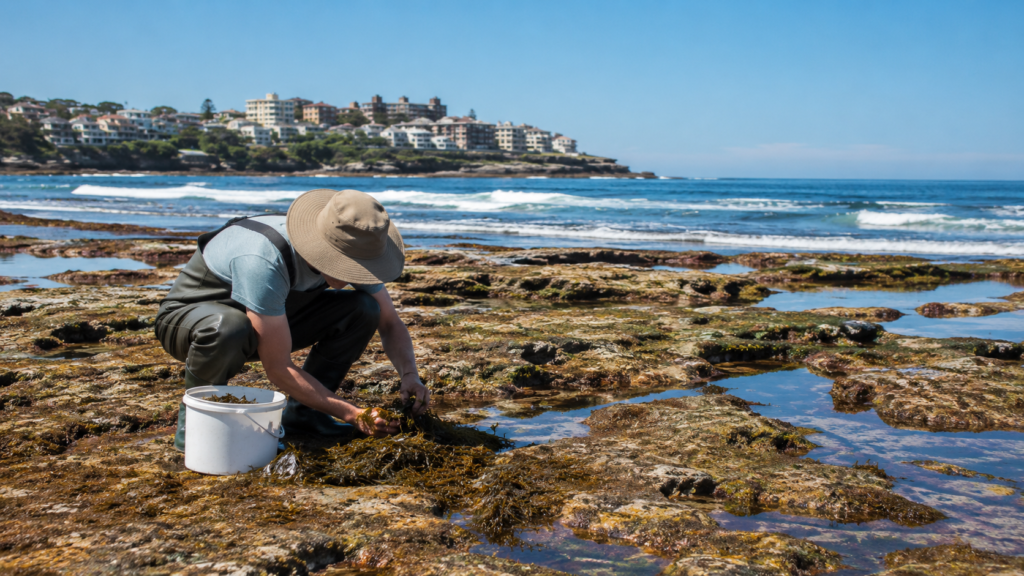
Seaweed foraging Sydney has quietly become one of the city’s most talked-about coastal activities – and for good reason. Sydney’s coastline is home to over 600 species of marine algae, much of it edible, nutritious, and completely free to those who know where to look and how to harvest it responsibly.
This complete seaweed foraging Sydney guide covers everything a beginner needs to get started. From the best locations along the Sydney coast, to the species worth knowing, the rules and regulations that govern responsible harvesting, the tools to bring, and the recipes that turn your coastal finds into genuinely delicious food. Whether you are a complete beginner curious about connecting with Sydney’s coastline in a new way, or someone who has already discovered coastal foraging and wants to go deeper into the marine world, this guide is written for you.
Seaweed foraging Sydney is accessible, sustainable when done correctly, and opens up a relationship with the coast that most Sydneysiders never discover. Let us start from the beginning.
Why Seaweed Foraging Sydney Is Worth Your Attention
Before getting into specifics, it is worth understanding why seaweed foraging Sydney has attracted so much interest in recent years – because the reasons go beyond novelty.
Nutrition
Seaweed is among the most nutritionally dense foods available from any natural environment. The species found along the Sydney coast contain significant levels of iodine, which is essential for thyroid function and often deficient in modern diets. Many species are also rich in iron, calcium, magnesium, and B vitamins. Some contain unique antioxidants not found in land-based vegetables.
The omega-3 fatty acids found in certain seaweed species are particularly interesting – these are the same compounds found in fish, and their presence in seaweed reveals where fish get them in the first place. Eating seaweed is, in a very real sense, going directly to the source.
Sustainability
Seaweed foraging Sydney, done correctly and in small quantities for personal consumption, is one of the most sustainable food gathering activities available. Seaweed grows rapidly – many species regenerate within weeks of harvesting. It requires no freshwater, no fertiliser, no land clearing, and no fossil fuel inputs to produce. Collecting a small amount for personal use from the abundant species that line Sydney’s rock platforms represents essentially zero ecological impact when done responsibly.
Connection to Place
There is something fundamentally different about walking a Sydney headland with knowledge of what grows there. The rock platforms that most people walk across without a second glance become, with a forager’s knowledge, a landscape full of meaning – different species in different tidal zones, colours and textures that indicate age and condition, small ecosystems within ecosystems that most visitors never notice.
Seaweed foraging Sydney is as much about developing a relationship with the coast as it is about collecting food.
Understanding Sydney’s Coastline for Seaweed Foraging
Successful seaweed foraging Sydney begins with understanding the coastal environment. Sydney’s coastline has two distinct characters that produce different foraging opportunities.
The Ocean Coast
The exposed ocean beaches and headlands of Sydney’s eastern suburbs – from Cronulla in the south through Coogee, Bondi, and Manly to the northern beaches – face the full Pacific Ocean. The rock platforms here experience powerful wave action and strong tidal flushing, which creates conditions for robust, high-energy seaweed species. These platforms can be challenging to access and potentially dangerous in rough conditions, but they host remarkable diversity and abundance of marine algae.
The ocean coast is where seaweed foraging Sydney yields the greatest variety and the most dramatic harvesting environments. It is also where conditions change most rapidly and where the rules about safe access to rock platforms are most important.
The Harbour and Bay Coastline
The sheltered waters of Sydney Harbour and Botany Bay produce a completely different seaweed foraging Sydney environment. Here the species are adapted to calmer, sometimes less saline conditions, and the accessible foreshore areas are generally safer for beginners. Botany Bay in particular has extensive shallow foreshore areas that are excellent for introductory seaweed foraging Sydney experiences.
The Best Locations for Seaweed Foraging Sydney
Location 1: Bare Island, Botany Bay
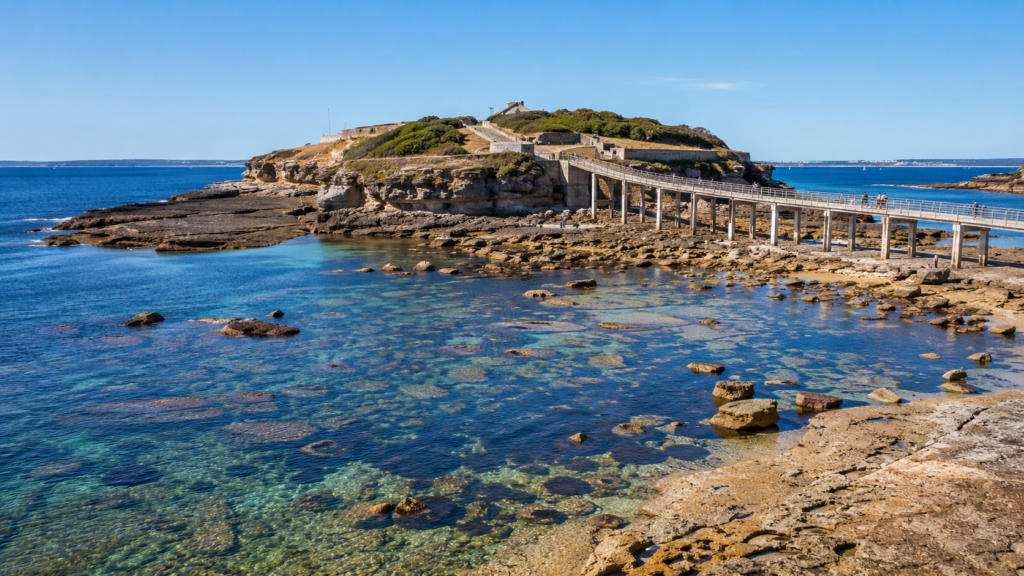
Bare Island in Botany Bay, connected to the mainland by a short footbridge at La Perouse, is one of the best accessible seaweed foraging Sydney locations for beginners. The rock platforms around the island are extensive, exposed at low tide, and host a good diversity of common edible seaweed species in a relatively sheltered environment.
The historical significance of this location adds another layer to the seaweed foraging Sydney experience here – Botany Bay is where Captain Cook made his first landing in Australia in 1770, partly because the lush plant life visible from the Endeavour impressed the expedition’s botanists. The seaweed-rich rock platforms were part of that abundance.
Access is straightforward – drive or bus to La Perouse, cross the footbridge to Bare Island, and explore the rock platforms to the south and east of the island at low tide. The platforms are wide, relatively flat, and safe in calm conditions.
Best species to find here: Sea lettuce (Ulva lactuca), Neptune’s necklace (Hormosira banksii), and various red algae species.
Location 2: Cape Banks, Botany Bay
The Cape Banks headland at the southern entrance to Botany Bay, accessed from the Kamay Botany Bay National Park, offers extensive rock platforms in a protected national park environment. Seaweed foraging Sydney in national parks requires awareness of specific regulations – see the rules section below – but the abundance and diversity of species here is outstanding.
The platform walk along the Cape Banks headland reveals a succession of tidal zones, each with its own seaweed community. From the high splash zone where the most desiccation-tolerant species survive, through the mid-tide zone of greatest diversity, to the low-tide zone where the largest and most impressive algae are found. A single low-tide walk here introduces most of the common seaweed foraging Sydney species in one location.
Location 3: Cronulla Headland and Rock Platforms
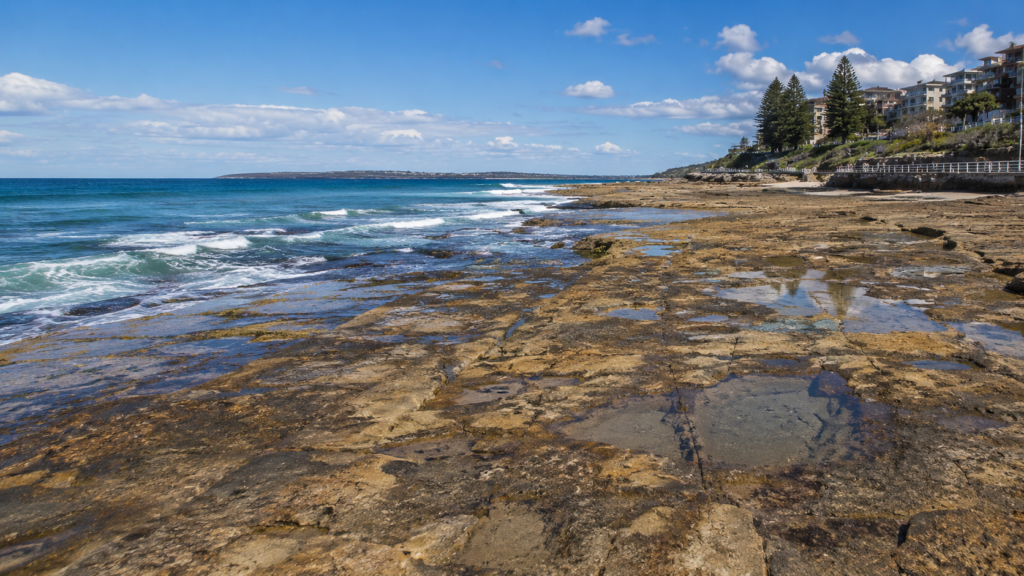
The Cronulla headland and the extensive rock platforms running south toward Kurnell provide some of the most productive seaweed foraging Sydney environments on the southern coast. The platforms here are wide, accessible, and rich with species adapted to the moderate wave exposure of this southern-facing coastline.
Seaweed foraging Sydney at Cronulla is particularly rewarding in autumn and winter when sea temperatures are cooler and many species are at their peak growth. The water clarity is also excellent in cooler months, making it easier to observe species in the lower tidal zones.
Location 4: Shelly Beach, Manly
The small Shelly Beach headland at Manly, on the northern side of the Manly peninsula, offers a protected rock platform environment that is excellent for introductory seaweed foraging Sydney. The headland sits within the Cabbage Tree Bay Aquatic Reserve, which has specific rules about what can and cannot be collected – again, see the regulations section below.
The marine environment at Shelly Beach is exceptional – it is one of the most species-rich coastal sites in Sydney – and the seaweed diversity reflects this broader ecological quality. For a seaweed foraging Sydney beginner who also wants to experience outstanding snorkelling and marine life, Shelly Beach combines both activities perfectly.
Location 5: Royal National Park Coastline
The coastline within the Royal National Park south of Sydney offers the most wild and extensive seaweed foraging Sydney experience available. The exposed headlands and rock platforms between Bundeena and Garie Beach are rich with species and entirely free from urban development and the associated water quality issues.
Seaweed foraging Sydney in the Royal National Park requires a vehicle entry fee but the quality and scale of the foraging environment justifies the investment. This is where seaweed foraging Sydney moves from suburban activity to a genuine wilderness experience.
Seaweed Species Guide: What to Look for on Your Sydney Forage
Learning to identify seaweed species is the foundation of safe and productive seaweed foraging Sydney. The following species are the most common, most identifiable, and most useful for culinary purposes on the Sydney coast.
Sea Lettuce (Ulva lactuca)
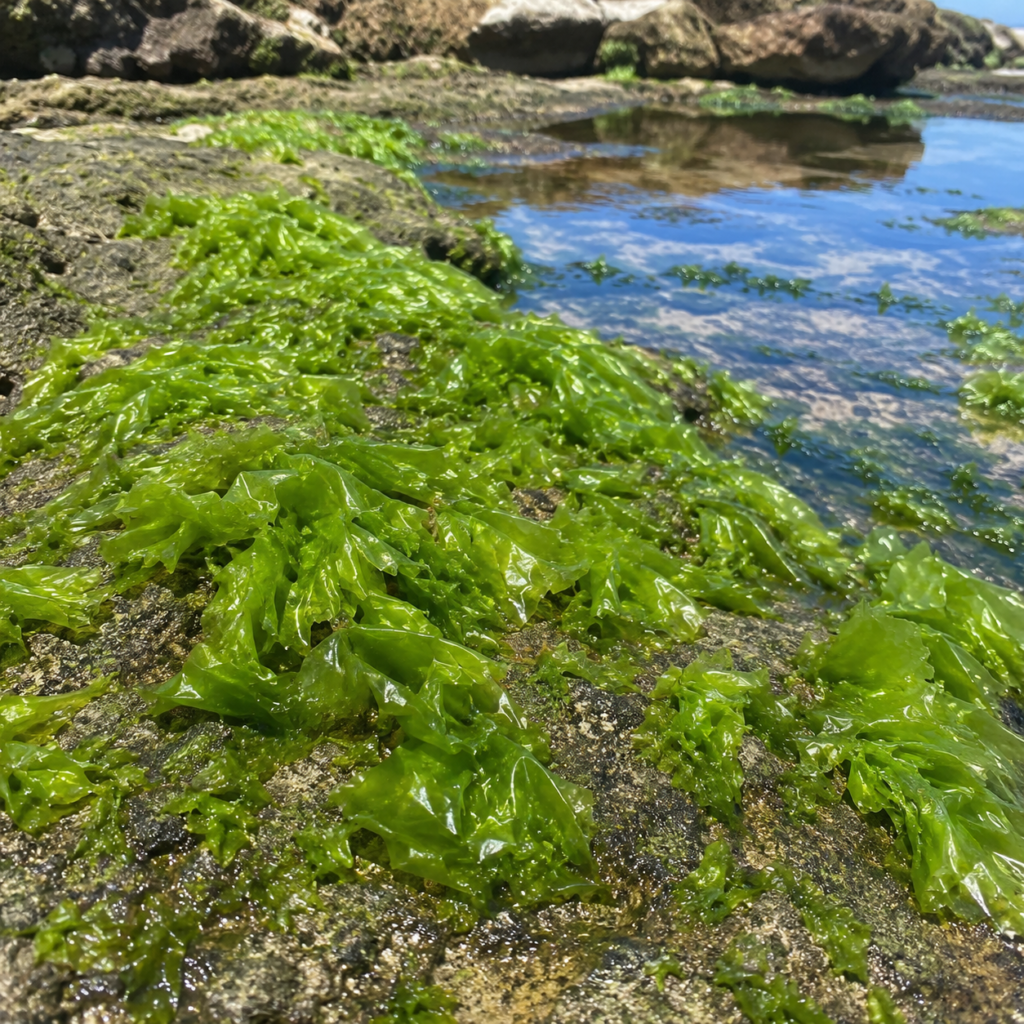
Sea lettuce is the entry point for seaweed foraging Sydney beginners and for good reason. Its bright, vivid green colour and thin, lettuce-leaf-like fronds make it unmistakable. It grows on rock surfaces throughout the intertidal zone and is one of the most abundant species on the Sydney coast.
Taste and use: Sea lettuce has a mild, slightly salty ocean flavour that intensifies when dried. Fresh, it can be added to salads, used as a wrap, or eaten directly. Dried and crumbled, it makes an excellent seasoning for everything from eggs to pasta. It is one of the most versatile species encountered in seaweed foraging Sydney.
Where to find it: On rocks throughout the intertidal zone, particularly in areas with some freshwater runoff. Abundant at all the locations listed above.
Harvest method: Cut fronds with scissors, leaving the holdfast (the base that attaches to rock) in place so the plant can regenerate. Take no more than one third of any individual plant.
Neptune’s Necklace (Hormosira banksii)
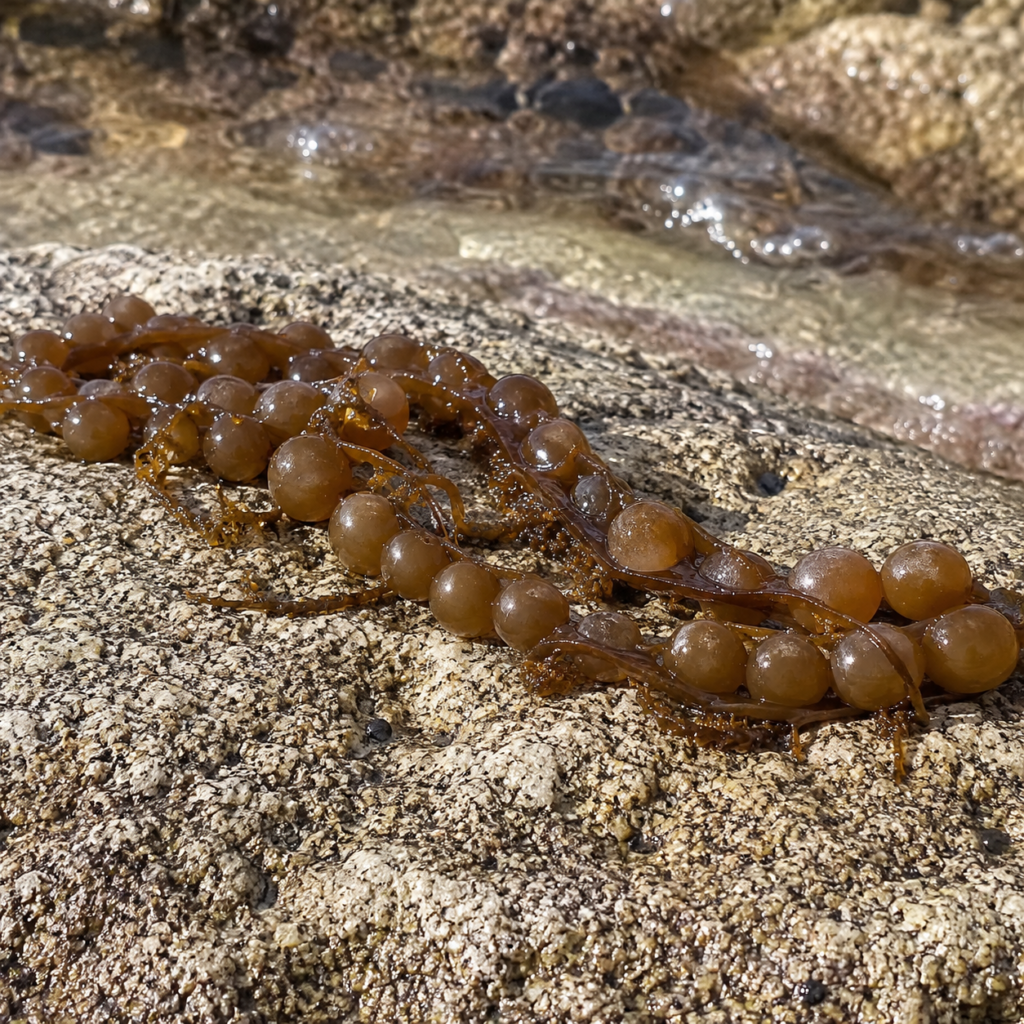
Neptune’s necklace is one of the most distinctive species in seaweed foraging Sydney – a brown alga with a chain of water-filled beads that gives it an immediately recognisable appearance. It grows in dense mats in the mid-intertidal zone and is extraordinarily common on Sydney’s rock platforms.
Taste and use: Neptune’s necklace has a stronger ocean flavour than sea lettuce and a satisfying pop when bitten. The water-filled beads contain a gel-like liquid that has a pleasant, mild taste. It is typically eaten raw as a snack during the forage itself or added to seafood dishes for a genuine ocean flavour.
Where to find it: Mid-tide zone rock surfaces throughout Sydney’s ocean and harbour coast. One of the first species beginners encounter in seaweed foraging Sydney.
Harvest method: Pull gently from rocks – Neptune’s necklace detaches easily. Select healthy, firm specimens and avoid any that appear damaged, bleached, or slimy.
Wakame (Undaria pinnatifida)
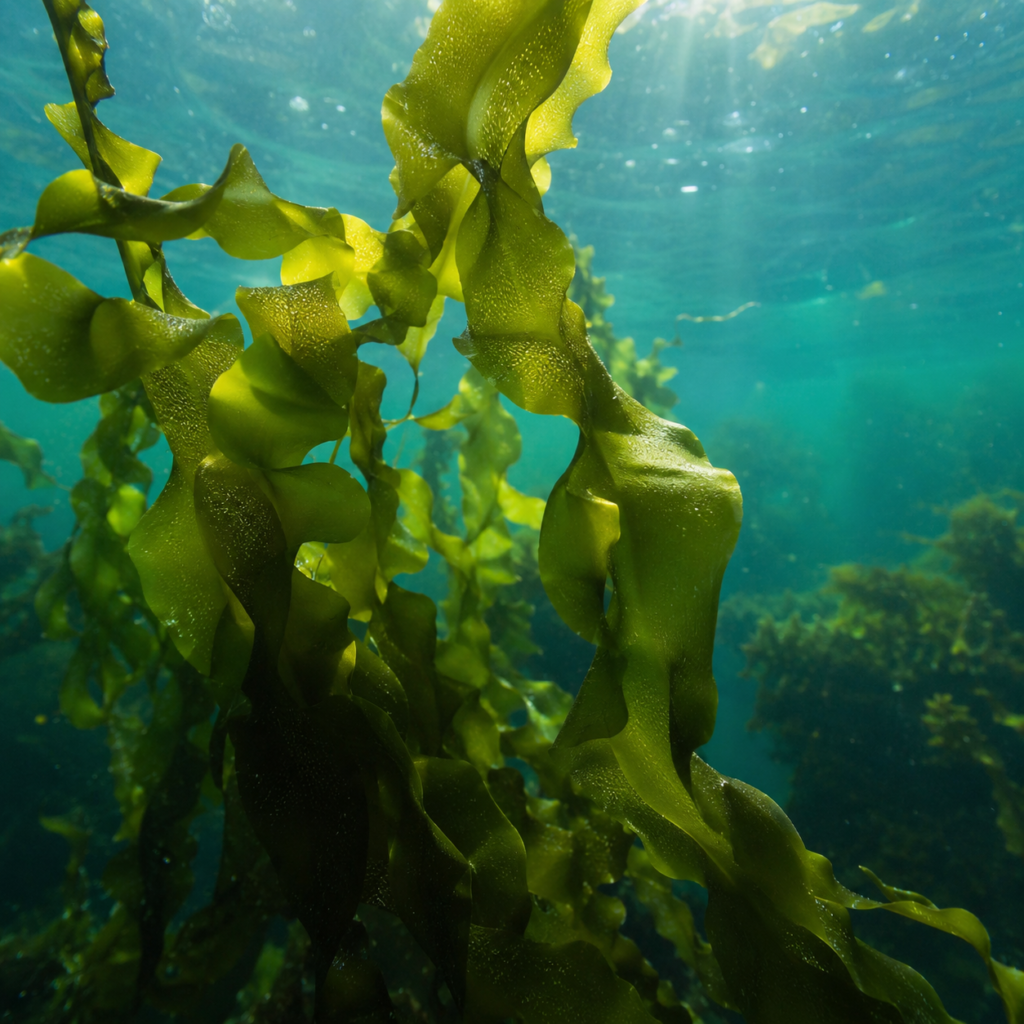
Wakame is the seaweed familiar from Japanese miso soup and it grows abundantly on Sydney’s southern coast, having established itself as a naturalised species in Australian waters. Its presence in seaweed foraging Sydney is ecologically interesting – it is technically an introduced species, which means collecting it is not subject to the same conservation considerations as native species and is actively encouraged by environmental managers.
Taste and use: Wakame is excellent in miso soup, salads, and noodle dishes. Its mild, clean ocean flavour and silky texture make it the most immediately approachable seaweed for cooking. Blanched briefly in hot water and dressed with sesame oil and soy sauce, it makes a beautiful simple salad. Dried wakame reconstitutes quickly in water and stores well.
Where to find it: Subtidal and low intertidal zones on rocky substrates. Most accessible during very low tides and in the cooler months when it grows most vigorously. Common on the Cronulla and southern Sydney rock platforms.
Harvest method: Cut with scissors leaving holdfast intact. Because wakame is an introduced species in Australia, there is no conservation concern about harvesting it in quantity for personal use.
Ecklonia Radiata (Common Kelp)
The most common kelp species on the Sydney coast, Ecklonia radiata, forms the foundation of many of Sydney’s subtidal reef ecosystems. Its large brown fronds grow from rock surfaces below the low tide line, creating underwater forests visible from rock platforms during very low tides.
Taste and use: Ecklonia is the base ingredient for kombu-style stock – dried fronds steeped in water produce a deeply savoury dashi stock that forms the foundation of Japanese cooking. The glutamates naturally present in this kelp species are responsible for the umami flavour that makes dashi so important in cooking. Seaweed foraging Sydney for Ecklonia specifically for stock-making is highly worthwhile.
Where to find it: Low intertidal to subtidal zone – most accessible during very low spring tides. Look for it hanging in the water from rock platform edges.
Harvest method: Collect fronds that have washed up naturally before looking for attached specimens. Only harvest from the tips of attached fronds, leaving the main plant intact.
Carrageen (Chondrus crispus and related species)
Several red algae species in the carrageen family grow on Sydney’s rock platforms. These fan-shaped red to purple algae grow in the lower intertidal zone and contain carrageenan – a natural gelling agent with both culinary and health applications.
Taste and use: Carrageen species are most useful dried and used to thicken soups, stews, and desserts. They dissolve when simmered in liquid, producing a gel that sets on cooling. Traditional Irish carrageen pudding uses this property to create a panna cotta-like dessert. Seaweed foraging Sydney for carrageen species is most productive in winter when they are at peak growth.
Where to find it: Lower intertidal zone, often in pools and on shaded rock surfaces. Look for the distinctive fan-shaped purple red fronds at Cronulla, Cape Banks, and other ocean-facing platforms.
Rules and Regulations for Seaweed Foraging Sydney
Responsible seaweed foraging Sydney requires understanding the rules that govern what you can collect, where, and in what quantities. Ignorance of these rules is not a defence.
NSW Fisheries Rules
Under NSW Fisheries Management Act provisions, recreational collection of seaweed for personal consumption is generally permitted in small quantities from most publicly accessible coastal areas. The key rules for seaweed foraging Sydney under NSW Fisheries are:
You must not collect seaweed for commercial purposes without a licence. Personal consumption quantities only.
You must not use mechanical or powered equipment for collection. Hand collection with scissors or by hand only.
The collection must not damage the reef or rock platform substrate.
Aquatic Reserve Rules
Certain Sydney locations are designated aquatic reserves where collection rules are stricter. The Cabbage Tree Bay Aquatic Reserve at Manly, which includes the Shelly Beach area mentioned above, prohibits the collection of any marine organism including seaweed without a specific permit. Seaweed foraging Sydney at Shelly Beach means observing and learning only – no collecting.
Check the NSW Department of Primary Industries website for current aquatic reserve boundaries before visiting any new seaweed foraging Sydney location.
National Park Rules
Inside national parks including Royal National Park and Kamay Botany Bay National Park, collection of natural materials including seaweed is generally prohibited without a specific scientific or educational permit. Seaweed foraging Sydney in national parks is primarily an observational activity rather than a harvesting one.
The Sustainability Rule
Beyond the legal requirements, responsible seaweed foraging Sydney follows an ethical sustainability rule: take no more than you will use, harvest in a way that allows the plant to regenerate, and spread your collection across multiple plants rather than stripping any single specimen.
The Sydney coast’s seaweed populations are generally healthy and abundant. Keeping them that way for future visitors and for the marine ecosystems that depend on them is the responsibility of everyone who engages in seaweed foraging Sydney.
Seaweed Foraging Sydney: Tools and Equipment
Essential Tools
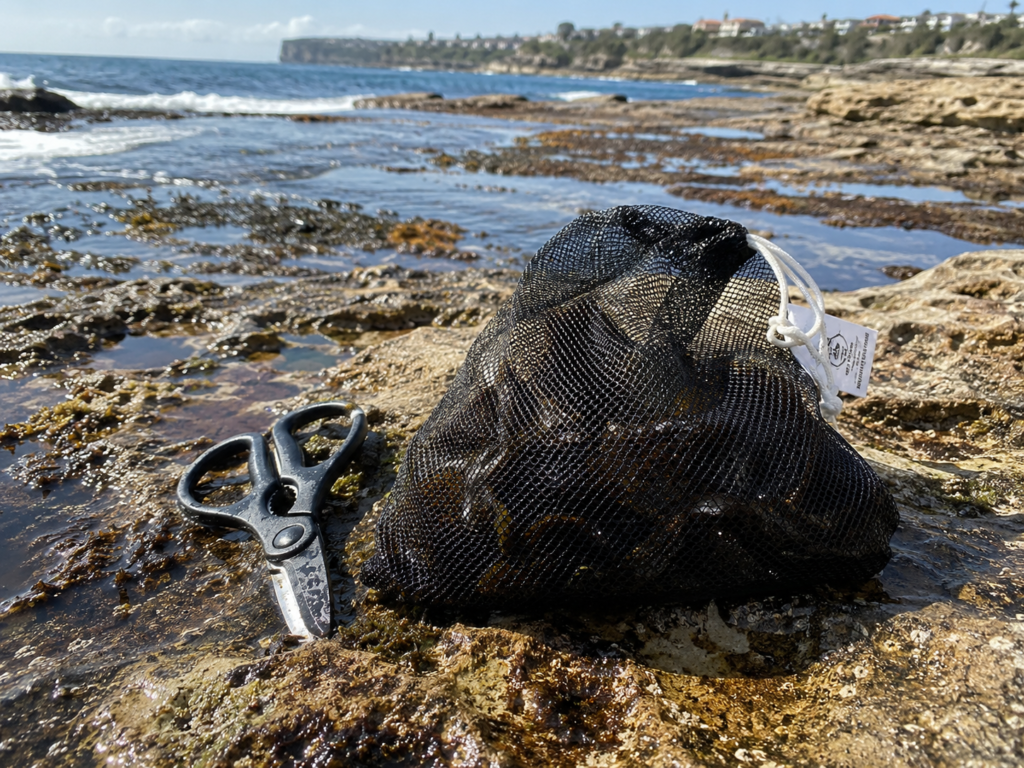
Scissors or small pruning snips: The most important tool for seaweed foraging Sydney. Clean, sharp scissors allow precise cutting that leaves the plant’s holdfast intact for regeneration. Cheap stainless steel scissors from a kitchen supply shop are entirely adequate.
Mesh bag or colander bag: A mesh bag allows water to drain away as you collect, keeping your harvest fresh without the weight of excess water. Available from fishing supply stores or online.
Rubber boots or water shoes: Rock platforms are slippery when wet and covered in algae. Proper footwear is essential for safe seaweed foraging Sydney. Wellington boots or purpose-made water shoes with good grip are both suitable.
Gloves: Thin rubber or neoprene gloves protect hands from sharp barnacles and rough rock surfaces encountered during seaweed foraging Sydney. Not strictly essential but worthwhile for extended sessions.
Helpful Additional Items
Field guide: A waterproof field guide to Australian seaweeds, such as the Marine Algae of Sydney (available from the Australian Museum shop or online) is the best reference companion for seaweed foraging Sydney. Being able to confirm identification in the field is invaluable for beginners.
Phone in waterproof case: For photographs of species for later identification and for checking tide times on the Bureau of Meteorology app during your seaweed foraging Sydney session.
Small cooler bag with ice: Keeps harvested seaweed fresh during transport. Seaweed deteriorates quickly at room temperature, particularly in summer. A cooler bag extends the usable window significantly.
Tides and Timing for Seaweed Foraging Sydney
Seaweed foraging Sydney is fundamentally tide-dependent. Getting the timing right makes the difference between an abundant, accessible forage and a frustrating experience.
The Ideal Window
The best seaweed foraging Sydney occurs in the two hours before and one hour after low tide. During this window, the largest area of rock platform is exposed, the lowest tidal zones are accessible, and the full range of species from different zones is available simultaneously.
Check tide times before every seaweed foraging Sydney session. The Bureau of Meteorology website provides free, accurate tide predictions for Sydney and surrounding locations. Search for BOM tide times Sydney and bookmark the page.
Spring Tides: The Premium Opportunity
The lowest tides of the month occur around new moon and full moon – these are called spring tides and they produce tide levels significantly lower than average. During spring low tides, seaweed foraging Sydney accesses parts of the platform normally submerged, revealing the largest kelp species and the greatest diversity of lower-zone species. If you can align a seaweed foraging Sydney session with a spring low tide, the experience is notably richer.
Safety and Tide Awareness
Never become so absorbed in seaweed foraging Sydney that you lose track of the tide turning. The return of the tide on exposed ocean platforms can be rapid and the rock surface becomes slippery quickly as water returns. Always be aware of which direction the water is moving and maintain a clear path back to safe ground throughout your seaweed foraging Sydney session.
Seaweed Foraging Sydney: Simple Recipes to Try
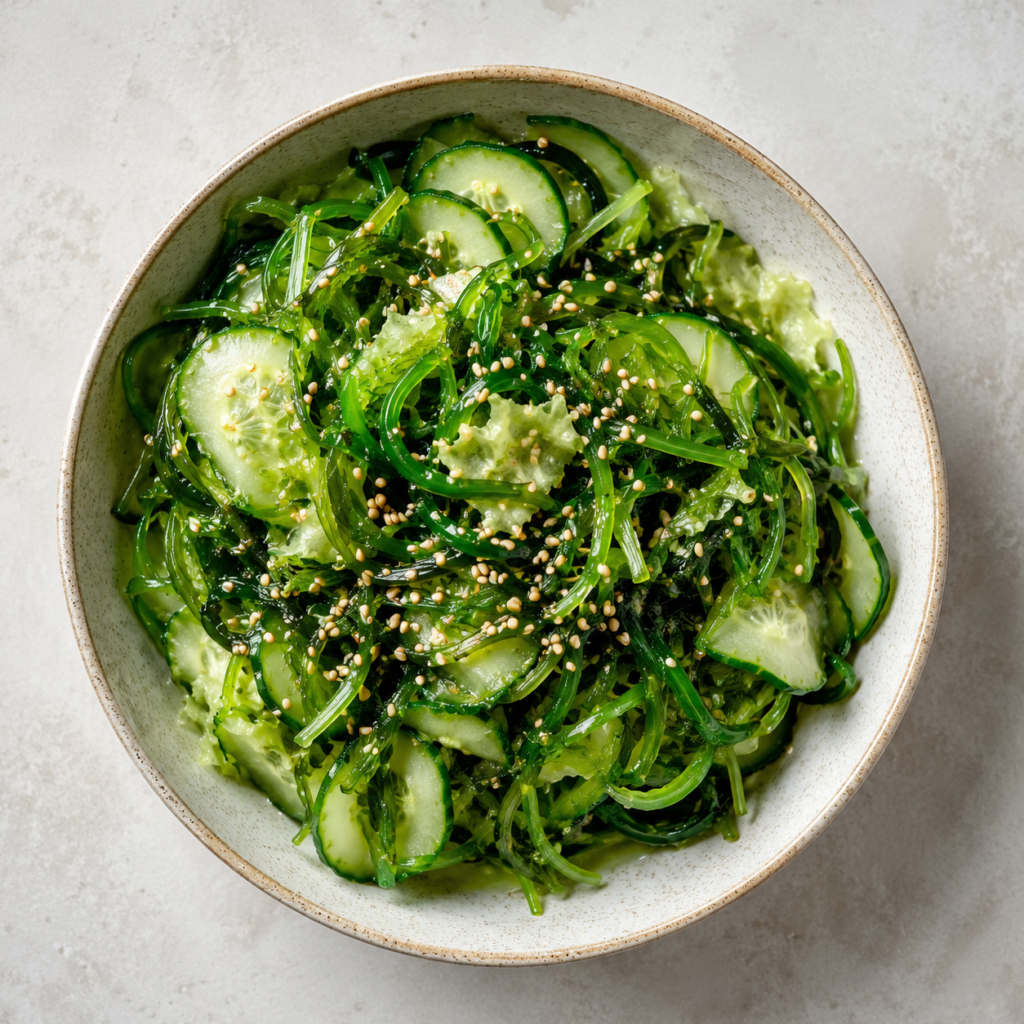
Sea Lettuce and Cucumber Salad
This simple recipe makes excellent use of the sea lettuce most commonly found during seaweed foraging Sydney.
Rinse fresh sea lettuce thoroughly in fresh water to remove sand and salt. Pat dry. Slice cucumber thinly and combine with torn sea lettuce. Dress with rice wine vinegar, a small amount of sesame oil, a pinch of sugar, and toasted sesame seeds. The sea lettuce brings a gentle ocean flavour that pairs beautifully with the clean cucumber.
Seaweed Stock (Dashi)
Dashi stock using Ecklonia kelp or dried wakame collected during seaweed foraging Sydney is the foundation of extraordinary soups, noodle dishes, and sauces.
Dry your collected kelp fronds completely in a single layer at room temperature or on the lowest setting of an oven with the door slightly open. Once completely dry, store in an airtight container. To make stock, steep a palm-sized piece of dried kelp in cold water for 30 minutes, then bring slowly to a simmer. Remove the kelp just before boiling – never boil kelp or the stock becomes bitter. The resulting liquid is a deeply savoury, clean-flavoured stock that transforms simple dishes.
Neptune’s Necklace on the Rock
The simplest recipe from seaweed foraging Sydney requires no preparation at all. Pick fresh Neptune’s necklace from the rock, rinse briefly in the nearest clean pool, and eat immediately. The beads pop between your teeth releasing a clean, cold ocean liquid. It is as close as food gets to tasting directly of the sea.
Seaweed Foraging Sydney Courses and Guided Experiences
If the prospect of beginning seaweed foraging Sydney alone feels daunting, several options exist for guided introductions.
The Wild Harvest Sydney events run periodic guided coastal foraging sessions that include seaweed identification and harvesting as part of a broader coastal food introduction. These events typically take place on Sydney’s southern headlands and include cooking demonstrations using foraged ingredients.
The University of New South Wales occasionally offers public education programs on Sydney’s marine algae through its marine biology department. These are more scientifically oriented but provide excellent foundational knowledge for seaweed foraging Sydney.
Several private guides offer bespoke coastal foraging experiences in Sydney, combining rock pool ecology with seaweed and shellfish foraging education. Search for coastal foraging Sydney guide for current operators – this sector has grown significantly in recent years.
Frequently Asked Questions About Seaweed Foraging Sydney
Is seaweed foraging Sydney legal? Collecting small quantities of seaweed for personal consumption is legal from most publicly accessible coastal areas in NSW. It is prohibited in aquatic reserves and national parks, and commercial collection requires a licence. Always check current regulations for your specific location.
Is it safe to eat seaweed from Sydney’s coast? Seaweed from Sydney’s coast is generally safe to eat when collected from areas with good water quality, away from stormwater outlets, and not during or immediately after heavy rainfall events. NSW Health monitors water quality at coastal locations throughout Sydney. Avoid collection from areas near industrial facilities, stormwater drains, or heavily urbanised foreshore areas.
What is the best time of year for seaweed foraging Sydney? Autumn and winter are generally the best seasons for seaweed foraging Sydney. Cooler water temperatures promote the growth of many edible species, water clarity is often better than in summer, and many species are at their peak condition during this period.
Do I need special equipment for seaweed foraging Sydney? Basic equipment is sufficient for beginning seaweed foraging Sydney. Clean scissors, a mesh bag, water shoes with grip, and a tide table are all you genuinely need to start. More specialised equipment adds comfort and efficiency but is not essential for the initial experience.
Can children participate in seaweed foraging Sydney? Seaweed foraging Sydney is an excellent family activity for children from approximately 6 years upward. The combination of rock pool exploration, wildlife spotting, and the novelty of collecting and eating food directly from the environment engages children very effectively. Choose sheltered, accessible locations like Bare Island for family seaweed foraging Sydney sessions and supervise closely near the water.
Final Thoughts: Seaweed Foraging Sydney
Seaweed foraging Sydney is one of those activities that starts as curiosity and becomes a practice. The first time you walk a rock platform with an ability to name and use what grows there, the coast transforms from scenic backdrop to living larder – abundant, self-renewing, and full of flavour that no shop can replicate.
Sydney’s coastline is extraordinarily rich. The 600 plus species of marine algae that grow here represent one of the most diverse seaweed environments in the southern hemisphere. Most Sydneysiders walk over this abundance every weekend without a second glance.
Seaweed foraging Sydney gives you the eyes to see what has always been there.
Start with sea lettuce and Neptune’s necklace. Learn the tides. Respect the rules. Take only what you will use. And let the coast teach you the rest.
Have you tried seaweed foraging in Sydney? Share your experience and your favourite spots in the comments below. And if this guide helped you get started, share it with someone who needs a reason to look more carefully at the rocks.
Related Articles:
- Best Rock Pools in Cronulla Sydney
- Kyeemagh Beach Sydney: Complete Local Guide
- Beaches Near Sydney CBD: Complete Guide
Sydney Hidden Gems – uncovering what makes Sydney extraordinary, one coastal discovery at a time.